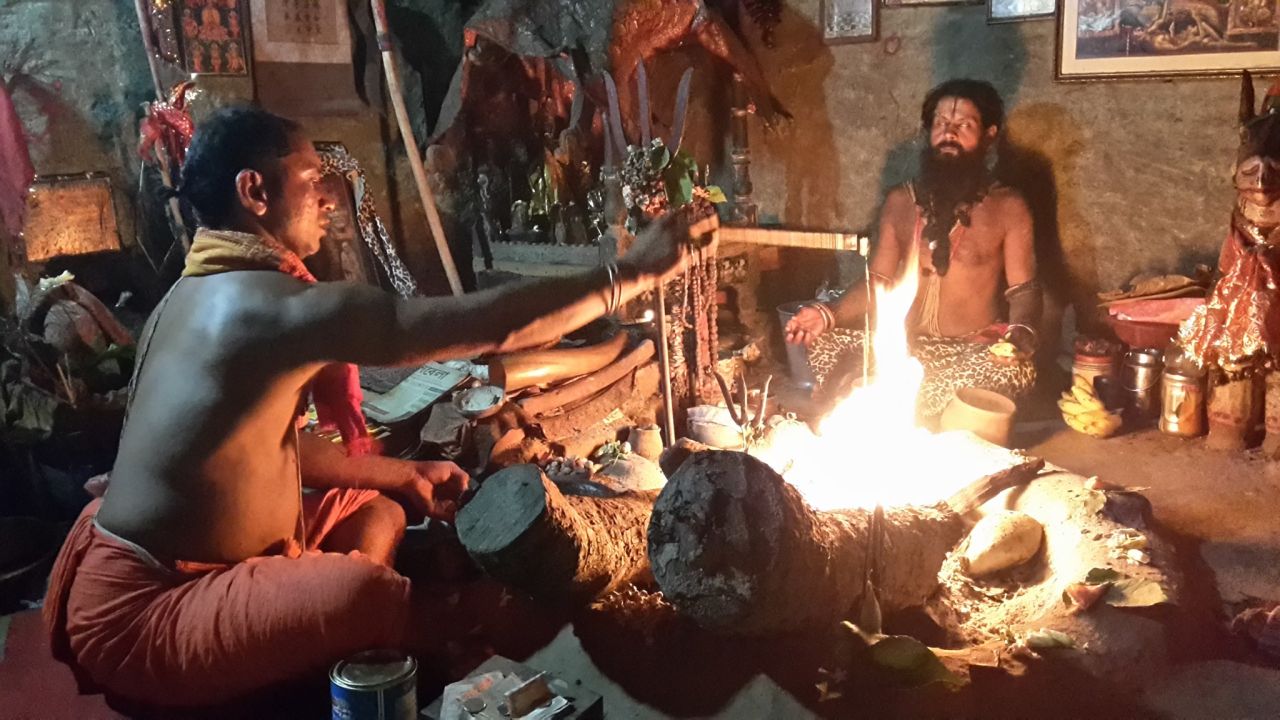
In North India the sadhus keep akhanda dhuni, which they worship three times a day and keep burning continuously. It is the same as nitya yagya (daily fire sacrifice).
Once upon a time, every house used to keep ever burning fire in the kitchen, because it was not so simple to light fires as we do today with matches. If your kitchen fire went out, you would go to your neighbor to borrow fire.
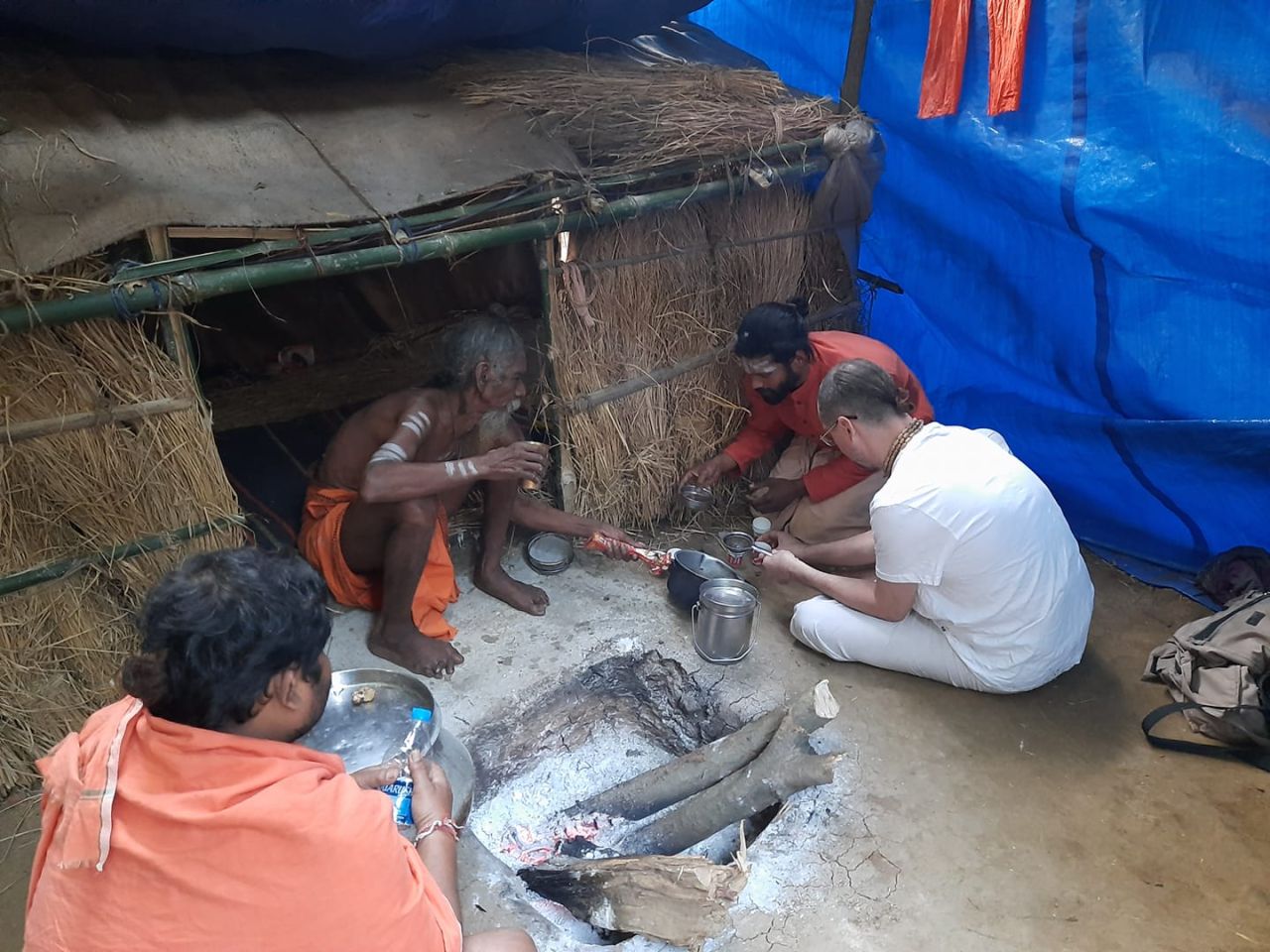
The longer a fire burns, the divine presence becomes magnified. Generally if one does yagya three times a day, that fire will still be present in the morning and one does not need to light the fire again.
The cremation fire in Kashi has been burning for 5,000 years. There is a dhuni at Manikarnika Ghat that has been burning from time immemorial. For every cremation, they light straw from this dhuni and carry the fire to the cremation pyre.

Manikarnika Ghat, the ancient dhuni is located inside those three arches.
Bhagavan is present in fire, and communication and delivery throughout the universe is done through fire.
brahmārpaṇaṁ brahma havir
brahmāgnau brahmaṇā hutam
brahmaiva tena gantavyaṁ
brahma-karma-samādhinā
The offering instrument is brahman, the oblation is brahman, the fire is brahman…
saha-yajñāḥ prajāḥ sṛṣṭvā
purovāca prajāpatiḥ
anena prasaviṣyadhvam
eṣa vo ’stv iṣṭa-kāma-dhuk
“In the beginning of creation, the Lord of all creatures sent forth generations of men and demigods, along with sacrifices for Vishnu, and blessed them by saying, “Be thou happy by this yajna [sacrifice] because its performance will bestow upon you all desirable things.” – Bhagavad Gita 3.10

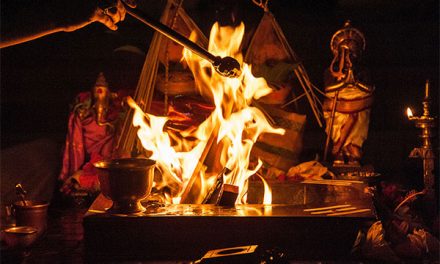
Akhanda Dhuni at our Ashram in Chennai

Every cow and calf at our sanctuary has a story of rescue, healing, and hope. Your generous support provides them with food, shelter, medical care, and a lifetime of protection. Together, we can give these sacred animals the love and safety they deserve.
hope this age come back
Thank you for this wonderful post.
Really a nice article.
Dear Sir,
Thank you for enlightening me.
Darshana Samarakoon
Wonderful- Hare Krsna !
Explaining the rationale behind our rituals go a long way in inculcating our traditions among the young generation. Your efforts in this direction are laudable.
great , please spread the awareness and rationale for unification .Thanks
NIce . Thanks for lighting the fire in me this early morning with the fruitful information.
Zoroastrian Parsis in India are religious refugees from ancient Persia, who were granted sanctuary by the gracious tolerant King of Gujarat, Jadi Rana about 1300 years ago. The Zoroastrian religion has many similarities to Vedic Hindusim, the ancient hymns are in the Avestan language, a sister of Vedic Sanskrit. For example Sanskrit Mantra = Avestan Mathra, Sanskrit Yagna = Avestan Yasna. Our Yashts are Avestan hymns to the Sun, Fire, Water, Earth, Light, Stars and so on, much like Vedic verses. We have continously burning holy fires in our Fire temples tended day and night by the Athravans, fire priests. Sadly due to the effects of the modern age, such as late marriage, inter-marriage, and less or no children, this ancient community and religion is reducing in numbers (we do not believe in any conversion). Good people, please pray that the spiritual power of India protects this ancient sister religion to which it has given gracious sanctuary for 1300 years. God bless the land of India, and the Indian people.
Thanks for the article.
Absolutely good feelings after reading it.
Very nice article. Got enlightened.
When the Bhopal Gas tragedy struck the only survivors of this chemical genocide unleashed by Union Carbide (now Dow Chemicals) were a family of Agnihotri Brahmins (those who perform Agnihotram twice a day) who lived right in the midst of the most severely affected zone. But the Mainstream media glossed over it. Just like how they glossed over the fact during the Tsunami of 2004 the sea receded inside 2 kms near the sea shore Subramania Swamy Temple at Tiruchendur while destruction was widespread in all areas surrounding the place, legend has it that the Samudra Raja promised Subramania Swamy that he will not touch the temple or his devotees.
Fire = AGNI is another name of Shiva. It also is name of our country Bharat. Shiva is represented as an upward triangle in the Sriyantra symbol. Thus the worship of fire is very fundamental to our culture.
Glad for this information, all the way in Trinidad and Tobago. My ancestral roots are deep and sacred and I’m proud to be a Hindu
Excellent exposition. I eagerly look forward to your articles and avidly read them.
So impressed, that’s why the Brahmins were Agnihotri, thanks for sharing